Real Madrid Barcelona remains the most closely watched rivalry in Spanish football, a contest shaped by trophies。politics, identity and the personal battles of its greatest players. Whenever the two clubs meet, the result carries consequences far beyond three points. A late winner can alter a title race, change a coach’s standing or turn a promising season into a crisis within minutes. The rivalry has produced unforgettable nights, from Lionel Messi’s famous celebration at the Santiago Bernabéu to Real Madrid’s dramatic comebacks under Zinedine Zidane. It also continues to evolve. Barcelona’s emphasis on academy graduates and positional football contrasts with Real Madrid’s ability to assemble elite talent from across the world. That difference gives every meeting a distinct tension: one side often tries to control the rhythm, while the other waits for the moment to strike at full speed.Recent encounters have shown how quickly the balance can shift. Barcelona’s success during the 2024-25 campaign, including domestic silverware and a younger attacking core, restored confidence around a club still managing serious financial pressure. Lamine Yamal became a central figure in that rise, combining fearless dribbling with the calm decision-making of a far more experienced player. His performances gave the Real Madrid Barcelona contest a new personal storyline。particularly because the winger represents the kind of homegrown talent Barcelona has historically celebrated. Real Madrid, meanwhile, continued to rely on the explosive quality of players such as Vinícius Júnior and the finishing power of Kylian Mbappé. Their presence changed the geometry of the rivalry. Barcelona could no longer afford to push its defensive line forward without calculating the danger behind it.For Real Madrid, the central challenge has been maintaining control when Barcelona turns possession into pressure. In several recent matches, Barcelona’s midfield has attempted to overload the center, move the ball quickly and force Real Madrid’s defenders into uncomfortable decisions. The response from Real Madrid has often been more direct: absorb the first wave, release the ball into space and attack the channels behind Barcelona’s full-backs. That tactical contrast makes the Real Madrid Barcelona fixture unusually sensitive to the opening goal. Barcelona can become more aggressive after scoring, while Real Madrid has repeatedly shown an ability to recover from difficult positions. The psychological element is difficult to measure。but it is visible in the final stages of close games. Players glance at the scoreboard, coaches adjust their shape and the crowd begins to treat every possession as a possible turning point.
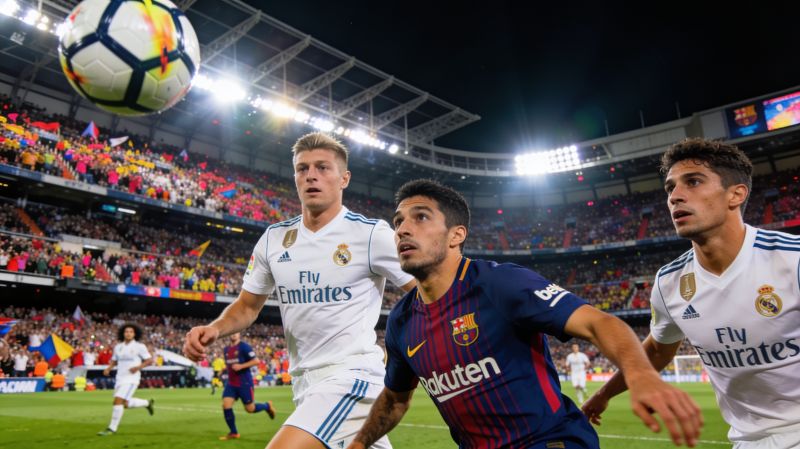
The rivalry also reflects the changing economics of elite football. Real Madrid’s renovated Bernabéu, global commercial reach and long-term recruitment strategy have strengthened its position as one of the sport’s most powerful institutions. Barcelona remains one of football’s biggest brands, yet its financial restructuring has forced difficult choices over transfers, wages and squad depth. The club has responded by trusting younger players。a policy that brings energy but also exposes inexperience in high-pressure moments. That contrast will remain important in future Real Madrid Barcelona meetings. A veteran Real Madrid lineup may manage a tense match through small details, while Barcelona’s emerging stars can transform the game with one daring run. Neither approach guarantees success. The rivalry has never rewarded reputation alone.
What makes Real Madrid Barcelona so compelling is the sense that every generation inherits the argument and then reshapes it. Older supporters still compare Alfredo Di Stéfano with Johan Cruyff。while younger fans debate Messi, Cristiano Ronaldo, Vinícius and Yamal. Coaches change, tactical systems move in and out of fashion, and transfer budgets rise, but the emotional stakes remain remarkably stable. A victory is celebrated as proof of superiority;a defeat is examined as evidence of deeper failure. The next Real Madrid Barcelona meeting will therefore be judged not only by the scoreline but by the direction it suggests. Can Barcelona’s young core withstand the pressure of a full season?Can Real Madrid’s star power deliver consistent control rather than isolated brilliance?Those questions give the fixture its enduring force, and they ensure that another chapter will command attention long before kickoff.